
Contents
Why Her Success Was Controversial
March is Women’s History Month, and March 8 is a reminder that women’s independence has often been shaped by women willing to challenge public norms.
One of the most influential figures in that story was Beate Uhse, a German entrepreneur who helped change how modern Europe talked about sex, contraception, and adult retail.
Beate Uhse is often described as a controversial businesswoman, but that does not fully capture her impact.
She was also a pilot, a wartime ferry flyer, and a founder who recognized a major postwar need: women needed practical information about contraception, family life, and sexual health.
In conservative postwar Germany, that insight became the basis of a business empire and a lasting cultural shift.

Who Was Beate Uhse?
Beate Uhse was born in October 1919 in Cranz, then part of East Prussia and now Zelenogradsk in Russia’s Kaliningrad region.
Her upbringing was unusually open for the time.
Reports about her early life note that her parents took sex education seriously, explained where children came from, and even discussed contraception.
They also supported her ambition to become a pilot.
That support mattered.
Uhse learned to fly, competed in aviation events, and later worked as a stunt pilot in film.
In 1939, she married her flight instructor just hours before he was sent to war.
During World War II, she ferried aircraft for the Luftwaffe, was captured by British forces, and returned home months later to learn that her husband had died.
Widowed at a young age, she had to rebuild her life on her own.
How She Built Her Business
After the war, Uhse first made money by selling used household goods.
But as The Guardian wrote, her conversations with German women quickly revealed a deeper need.
Many were trying to rebuild family life under severe financial pressure.
Many also feared unwanted pregnancies while lacking reliable information about condoms or birth control.
That insight led to her first major idea: education before retail.
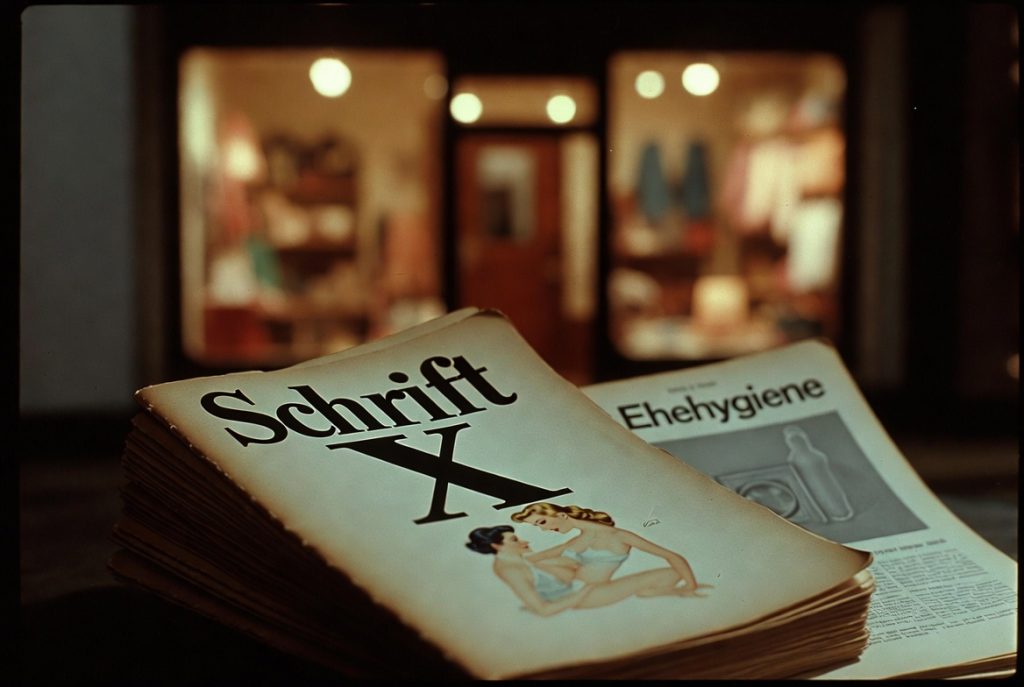
Her business began with “Schrift X” leaflets, which answered everyday questions about contraception and sex.
In 1951, she founded a company that sold “marital hygiene” books and condoms through mail order.
The concept was simple but powerful: offer private, practical access to products and information that people were often too embarrassed to ask for in public.
By the end of the 1950s, hundreds of thousands of Germans were buying from her.
In a society still shaped by shame and silence, Uhse built trust by treating sexual knowledge as an everyday need rather than a scandal.
She is also widely credited with opening the world’s first modern sex shop in Flensburg in the early 1960s.
The store sold basic sex toys, contraceptives, erotic lingerie, and related products that were difficult to buy openly in much of Europe at the time.
By 1971, she had expanded to 25 stores across West Germany.
That growth turned her name into a national brand and made her one of the best-known women entrepreneurs in Europe.
She was not just selling products.
She was helping normalize the idea that adults could seek sexual information and intimacy-related goods without moral panic.
Why Her Success Was Controversial

It is easy to project today’s language of openness backward, but 1950s West Germany was not especially sexually liberal.
Uhse’s success triggered a fierce conservative backlash.
Protesters reportedly burned some of her Bavarian stores.
In 1962, she was fined over a line of textured condoms.
Legal complaints and court cases followed her business for years, with critics claiming that Beate Uhse stores were corrupting public morals.
The stigma extended beyond the courtroom.
Uhse later recalled being denied entry to an elite tennis club in Flensburg in 1963 by a single vote.
That story reveals something important about her public image: she was not just selling taboo products, she was challenging ideas about who had the right to belong to respectable society.
That resistance is one reason her legacy still matters.
Beate Uhse did not succeed because Germany was ready for her.
She succeeded because millions of people needed what she was offering, even while parts of the culture pretended otherwise.
The Beate Uhse Empire
By the 1980s, the company had expanded far beyond mail order and storefronts.
According to a profile on the brand’s history, the Beate Uhse business included a retail network across Europe, specialized cinemas, and later a satellite television channel.
It had become one of the continent’s most recognizable adult retail brands.
After her death, however, the business struggled under later management.
In 2017, Beate Uhse AG filed for bankruptcy.
That ending does not erase the founder’s impact.
If anything, it separates her historical importance from the later fate of the company that carried her name.
Why She Still Matters Today

Beate Uhse once presented herself not as a moral reformer, but as a businesswoman responding to real demand.
That distinction matters.
She did not claim to improve society through idealism alone.
She understood that millions of marriages and private lives were shaped by silence, shame, and lack of access, and she built a business around practical solutions.
In the end, German authorities recognized her contribution to public life.
She received the Order of Merit of the Federal Republic of Germany and became an honorary citizen of Flensburg.
Her name also remained linked to Berlin’s erotic museum culture, showing that her influence extended beyond commerce into education and public memory.
Her legacy is larger than the phrase “sex shop pioneer.”
Beate Uhse helped move sexual knowledge out of whispers and into everyday life.
She turned contraception, intimacy, and adult retail into subjects that could be discussed, bought, and understood more openly.
In that sense, she changed not only a market, but part of the social vocabulary around sex itself.
One reason Beate Uhse remains relevant now is that her story was never just about products.
It was also about access to information.
In postwar Germany, many women were dealing with poverty, instability, and the fear of unwanted pregnancy.
Uhse understood that sex education and privacy were not luxury issues.
They were practical parts of everyday life.
That still feels current.
Public debates often focus on restriction, stigma, or panic, while people still need clear, science-based information they can trust.
If you follow how policy and culture intersect, browse our news hub, creators, and collections, as well as related tags on sex education, privacy, and relationships.
What happened to the Beate Uhse company?
The brand expanded across Europe, but Beate Uhse AG later struggled and filed for bankruptcy in 2017.